Aim of the module. After the meeting, students will be able to: explain how to obtain credit for the course; quote the definition of an AI system in Article 3(1) of Regulation (EU) 2024/1689 of the European Parliament and of the Council of 13 June 2024 laying down harmonised rules on artificial intelligence (Artificial Intelligence Act, ‘AI Act’) and break it down into its elements; distinguish an AI system from ordinary software; use the basic concepts (model, training data, parameters, machine learning, deep learning, NLP, generative AI); explain the difference between ANI, AGI and ASI; assess what the Turing test measures; identify what Article 4 AI Act requires of entities that use AI, including law firms.
Guiding question. When does a computer program become an ‘AI system’, and why should this matter more to a lawyer than to a philosopher?
1. Organisational matters
The lecture covers ten topics over eight meetings, 15 teaching hours in total (45 min each); meetings last 90 minutes, from 12:45 to 14:15. It combines three perspectives: technological and historical (topics 1–3), social and cultural (4–6 and 10) and legal (7–8), while topic 9 concerns the future of AI and the practice of implementation.
The course ends with a graded credit. Students choose one of three assessment paths.
- Path A: written test. 20 single-choice questions (1 point each) and 2 open questions (5 points each), 30 points in total. The open questions require applying legal provisions to a short set of facts or a critical assessment of a problem.
- Path B: project. A concept for an AI-based application that helps lawyers with a specific task (e.g. verifying case numbers cited in a pleading, reviewing contracts for unfair terms), together with an implementation plan: a document of 4–5 pages plus annexes: a flow diagram and draft screens. The project covers the problem and the user, the application concept, a legal analysis (AI Act, GDPR, professional secrecy, liability), risks and the implementation plan. The idea must be agreed with the lecturer by 6 November 2026. Criteria: concept and usefulness 30%, legal and ethical analysis 30%, implementation plan and risks 20%, sources and editing 20%.
- Path C: own proposal. A form of work of one’s own choosing related to the subject matter of the course, e.g. a prototype AI tool for lawyers, an analysis of a judgment or a legal case, a popular-science article, a podcast or a film. The proposal, with a short description and the method of assessment, must be submitted by 6 November 2026; the work is accompanied by a short written commentary with sources.
The pass threshold is 60% on all paths (scale: 60–67% satisfactory (dostateczny), 68–75% satisfactory plus (dostateczny plus), 76–83% good (dobry), 84–91% good plus (dobry plus), 92–100% very good (bardzo dobry)). The test and the submission of projects and own work take place during the winter examination session, 5–18 February 2027 (work no later than 18 February), and the resit deadline is 28 February 2027. Attendance is not compulsory. Participation in class, tasks with generative models and the quizzes on the course website can raise the grade by half a grade; quiz results are shown in the ‘Scorecard’ on the home page.
AI tools may be used in class and for study. A project must be accompanied by a statement of which tools were used and to what extent. The author is responsible for the accuracy of every source cited. A language model can invent a judgment with a plausible case number, and responsibility for the work lies with the person who signed it. Personal data and confidential documents should not be pasted into chats either. This is good practice already at university, and in the profession a requirement of professional secrecy and of Regulation (EU) 2016/679 (General Data Protection Regulation, GDPR).
2. ‘Quo vAIdis?’ Where are we?
The title of Andrzej Dragan’s book Quo vAIdis sums up the mood of the debate well: we do not know where we are heading, and we are not sure where we are. At the first meeting we focus on the second question.
Progress is easiest to see through examples. A few years ago, image-generating models still gave themselves away with badly drawn hands. Today the typical errors have shifted to small details: clock hands, lettering, reflections. Video models create scenes that at first glance look like a recording, although the movement is sometimes physically impossible. This leads to the question whether a model ‘understands’ the world it depicts, that is, whether it has a ‘world model’.
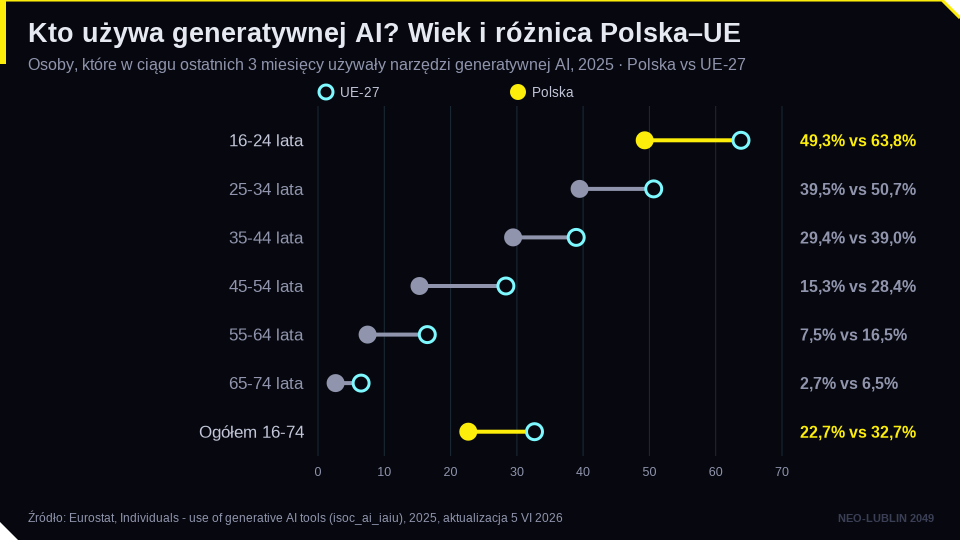
Attitudes also differ between generations. In a 2024 NASK survey, 70% of Polish students had already used AI-based tools; 52% rated AI positively (23% negatively), while among their parents 26% were positive and 42% negative (NASK, Nastolatki, 2025, N = 3665 students and 918 parents).
Fear of a new technology of knowledge is not new. In Plato’s Phaedrus (274c–275b), the Egyptian king Thamus warns Theuth, the inventor of writing, that writing will weaken memory and give people only the appearance of wisdom. In the lecture we listen to this passage read in the cloned voice of a well-known actor. This device itself shows how quickly technology enters areas protected by law: the voice is a personal interest (dobro osobiste, Article 23 of the Civil Code (k.c.)), and synthetic content is subject to the transparency obligations in Article 50 AI Act.
3. Definitions of artificial intelligence
Why is a definition problematic? There is no single definition of intelligence. There is also the so-called AI effect: what a machine can already do (chess, handwriting recognition, navigation) we stop calling intelligence. For a computer scientist, a definition describes a direction of research. For a lawyer, a definition determines the scope of application of the rules: whether a given product is subject to obligations under the AI Act depends on it.
Turing (1950). In his article Computing Machinery and Intelligence (Mind, 1950), Alan Turing considered the question ‘Can machines think?’ too vague. He replaced it with the imitation game, that is, a test of behaviour. This is a behavioural approach: we do not ask what a machine is, but what it does.
McCarthy. The term artificial intelligence comes from the proposal for a summer conference at Dartmouth (August 1955; the conference took place in 1956). The authors assumed that every aspect of learning and intelligence can be described so precisely that a machine can simulate it. McCarthy himself later defined AI as ‘the science and engineering of making intelligent machines, especially intelligent computer programs’.
Four approaches. The textbook by S. Russell and P. Norvig organises definitions along two axes: whether the focus is on thinking or on acting, and whether the benchmark is the human or rationality. Contemporary computer science and law mainly adopt the ‘rational agent’ approach, that is, a system that acts in order to achieve a goal.
OECD. The Recommendation of the OECD Council on Artificial Intelligence (2019) contains a definition of an AI system, updated in November 2023. Under it, an AI system is ‘a machine-based system that, for explicit or implicit objectives, infers, from the input it receives, how to generate outputs such as predictions, content, recommendations, or decisions that can influence physical or virtual environments. Different AI systems vary in their levels of autonomy and adaptiveness after deployment.’ The EU definition was based on this definition.
AI Act. Under Article 3(1) of Regulation (EU) 2024/1689, ‘AI system’ means ‘a machine-based system that is designed to operate with varying levels of autonomy and that may exhibit adaptiveness after deployment, and that, for explicit or implicit objectives, infers, from the input it receives, how to generate outputs such as predictions, content, recommendations, or decisions that can influence physical or virtual environments’.
In its guidelines on the definition of an AI system (published on 6 February 2025, formally adopted on 29 July 2025 as Communication C(2025) 5053 final), the European Commission identified seven elements of this definition:
- a machine-based system;
- designed to operate with varying levels of autonomy;
- may exhibit adaptiveness after deployment;
- operates for explicit or implicit objectives;
- infers from the input it receives;
- how to generate outputs (predictions, content, recommendations, decisions);
- the outputs can influence physical or virtual environments.
The most important element is the fifth. According to recital 12, the capability to infer distinguishes an AI system from simpler traditional software systems or programming approaches and from systems that are based on the rules defined solely by natural persons. The techniques that enable inference include machine learning approaches (the system learns from data how to achieve objectives) and logic- and knowledge-based approaches (the system infers from encoded knowledge).
Two common simplifications should be avoided. First, ‘autonomy’ does not mean operating without human oversight. It means some degree of independence of actions from human involvement. Second, adaptiveness after deployment is not a necessary condition: the provision says that the system ‘may’ exhibit it. A model that does not learn after deployment can still be an AI system.
The Commission’s guidelines give examples of systems outside the definition: systems for improving mathematical optimisation, basic data processing (sorting and filtering databases, standard spreadsheets), systems based on classical heuristics (e.g. a chess program based on the minimax algorithm) and simple prediction systems, e.g. a forecast based on the average of previous periods. The guidelines are not binding; the definition is ultimately interpreted by the Court of Justice of the European Union (CJEU).
Example. A program that calculates the court fee according to the table in the ustawa o kosztach sądowych w sprawach cywilnych (Act on Court Costs in Civil Matters) is not an AI system: it executes rules written by a human. A bank model trained on credit history to assess creditworthiness is an AI system, and may in addition be a high-risk AI system (Annex III, point 5(b) AI Act). The assessment depends on the technique, not on the name of the product. An ‘intelligent’ case-law search engine based on keywords does not infer; a semantic search engine based on a language model does.
4. Basic concepts
The concepts are nested like Russian dolls. Artificial intelligence is the whole field, including expert systems based on rules and knowledge. Machine learning is a subset of AI: the program is given not rules but examples, and derives patterns from them by itself. Deep learning is machine learning using multi-layer neural networks, which extract features from raw data (images, sound, text) by themselves. Generative AI means models that create new content.
A model is a mathematical function that transforms input data into an output. Training data are the examples from which the model learns. Parameters are numbers (weights) set during training; large language models have billions of them. Training (teaching the model) must be distinguished from inference (using the trained model). The AI Act also distinguishes an AI model from an AI system: a model becomes a system only once further components are added, e.g. a user interface (recital 97).
Machine learning is divided into supervised learning (examples with correct answers), unsupervised learning (finding structure in unlabelled data) and reinforcement learning (learning through rewards and penalties). We discuss the details at meeting 3. The legal consequence is worth remembering now: the quality of the output depends on the quality and representativeness of the data. This is why the AI Act requires data governance for high-risk AI systems (Article 10), and algorithmic bias is the topic of meeting 5.
Natural language processing (NLP) covers the recognition, analysis and generation of text and speech: translation, summarisation, classification of documents, transcription of recordings. For lawyers it is the most important branch of AI, because law is text. Today the main tools of NLP are large language models (LLMs).
Generative AI creates text, images, sound and video on the basis of instructions (prompts). Its output is probable, not true by definition. Hence so-called hallucinations, that is, convincing but false content (meeting 3), and the transparency obligations in Article 50 AI Act, which apply from 2 August 2026.
5. ANI, AGI, ASI. The Turing test and its critics
ANI (artificial narrow intelligence) is narrow AI, proficient in a specific task or group of tasks. All systems in operation today are ANI. AGI (artificial general intelligence) would mean general intelligence matching humans in most cognitive tasks. ASI (artificial superintelligence) is, according to Nick Bostrom, an intellect that greatly exceeds humans in virtually all domains. The boundaries are conventional. Large language models write, translate and program, so the dispute over whether they are still ‘narrow’ continues (we return to it at meeting 9).
The Turing test. A judge holds a text conversation with a human and a machine, neither of whom the judge can see. If the judge cannot identify the machine, the machine passes the test. Turing predicted that by around 2000 an average judge, after five minutes of conversation, would correctly identify the machine in no more than 70% of cases.
The test has serious critics. John Searle’s Chinese room (1980): a person locked in a room answers correctly in Chinese by arranging characters according to instructions, although they do not know Chinese. From the outside this looks like understanding. Searle concluded that manipulating symbols (syntax) does not produce understanding (semantics). The ELIZA effect: Joseph Weizenbaum’s program (1966), which imitated a psychotherapist using simple rules, convinced users that it understood them. Human judgement is easy to deceive, because people readily attribute human traits to machines.
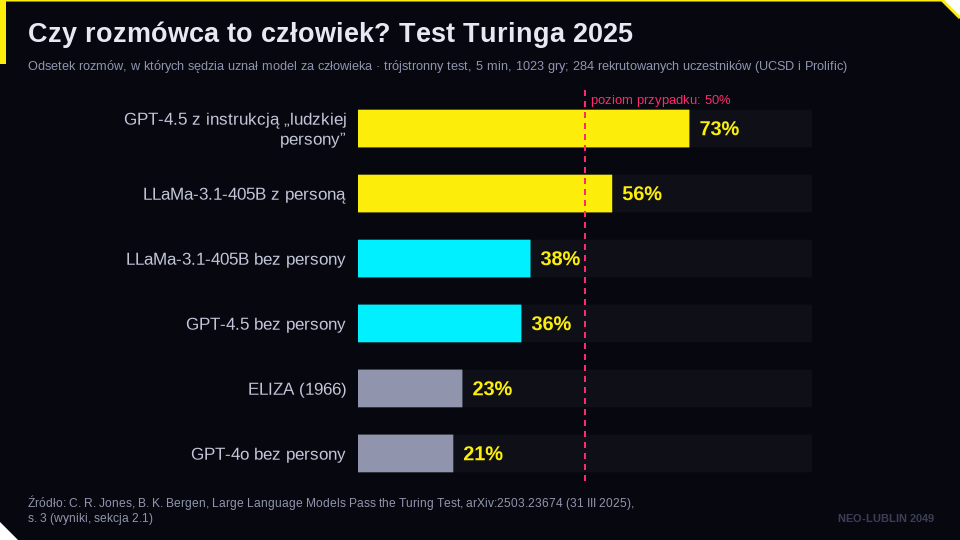
In 2025, C. Jones and B. Bergen conducted a three-party Turing test (the judge spoke simultaneously with a human and with an AI). GPT-4.5, instructed to adopt a ‘human persona’, was judged to be the human in 73% of conversations, that is, more often than the real humans. LLaMa-3.1-405B achieved 56%, and ELIZA and GPT-4o 23% and 21% respectively. The result shows that the test measures the ability to imitate, not understanding. A model can ‘pass’ because it imitates human weaknesses well.
The Voight-Kampff test from Philip K. Dick’s novel Do Androids Dream of Electric Sheep? (1968) and the film Blade Runner (1982) examines not intelligence but empathic reactions. Today models can describe empathy convincingly, so this criterion is weakening too.
The reverse Turing test in law. The law does not ask whether a machine thinks. It asks whether a human knows that they are talking to a machine. Article 50(1) AI Act requires providers to design systems intended to interact with people in such a way that they inform people that they are AI systems, unless this is obvious. Article 50(2) and (4) concern the marking of synthetic content and deepfakes.
6. Applications of AI and AI literacy
AI is used in medicine (analysis of diagnostic images), finance (scoring, fraud detection), transport, public administration (handling enquiries, translation) and on online platforms (recommendations, content moderation). In legal practice it is used for searching and analysing case law, reviewing documents and contracts (due diligence), preparing draft pleadings and summaries of case files, transcribing recordings, and as assistants in legal information systems. Examples include LEX Expert AI (Wolters Kluwer, since 2025), Lexis+ AI and, for law firms, Harvey or CoCounsel (Thomson Reuters).
A lawyer using AI must bear the risks in mind: hallucinations (invented judgments and provisions), professional secrecy and confidentiality, personal data protection, professional liability and excessive trust in automation (automation bias). The legal representative, not the model, is responsible for a pleading. Examples of sanctions for hallucinated judgments are discussed at meeting 8.
Article 4 AI Act provides that providers and deployers of AI systems ‘shall take measures to ensure, to their best extent, a sufficient level of AI literacy of their staff and other persons dealing with the operation and use of AI systems on their behalf’, taking into account their technical knowledge, experience, education and training and the context in which the systems are to be used. The provision has applied since 2 February 2025. Regulation (EU) 2026/1744 (the so-called Digital Omnibus on AI, in force since 27 July 2026) relaxed this obligation. Providers and deployers now ‘shall take measures to support the development of AI literacy’ of their staff, and the provision expressly states that ‘this obligation does not require providers or deployers to guarantee any specific level of AI literacy of any individual’. The duty to act remains, but its character has changed: from an obligation of result to an obligation of diligent support.
The concept of AI literacy is defined in Article 3(56): it means skills, knowledge and understanding that allow providers, deployers and affected persons to make an informed deployment of AI systems, as well as to gain awareness about the opportunities and risks of AI and the possible harm it can cause. A law firm, court or public office that uses an AI system is a deployer (Article 3(4)). It must therefore ensure that the persons who use the system are trained.
Key concepts
| Term | Working definition |
|---|---|
| AI system | a machine-based system which, with varying levels of autonomy and for explicit or implicit objectives, infers from the input it receives how to generate outputs that can influence environments (Article 3(1) AI Act) |
| inference | the capability of a system to derive outputs or models from data; distinguishes an AI system from software operating according to rules written by a human (recital 12) |
| AI model | a mathematical function that transforms input data into outputs; becomes a system once further components are added (recital 97) |
| parameters | the numbers (weights) of a model set during training |
| training data | the examples from which a model learns patterns |
| machine learning | an approach in which a system learns patterns from data instead of executing written rules |
| deep learning | machine learning using multi-layer neural networks |
| NLP | natural language processing: analysis and generation of text and speech |
| generative AI | models that create new content (text, images, sound, video) |
| ANI / AGI / ASI | narrow AI / general AI at human level / superintelligence exceeding humans |
| Turing test | a test of whether a machine’s behaviour in conversation is indistinguishable from a human’s |
| Chinese room | J. Searle’s argument: manipulating symbols is not understanding |
| deployer | a person or body using an AI system under its authority, except in the course of a personal non-professional activity (Article 3(4)) |
| AI literacy | the skills, knowledge and understanding needed for the informed use of AI (Article 3(56), Article 4) |
Exercises and discussion
Questions for discussion (in class)
- Is the definition in Article 3(1) AI Act too broad, too narrow or about right? Give an example of a system that in your view should be regulated but is not covered by the definition (or vice versa).
- Why did the EU legislature base the definition on ‘inference’ rather than on ‘learning’ or ‘intelligence’? What would change if adaptiveness were a necessary condition?
- A large language model ‘passed’ the Turing test in a 2025 study. Is this proof that it thinks? What is the legal significance of the fact that people cannot distinguish a conversation with a machine from a conversation with a human?
- Thamus in the Phaedrus warned that writing would give ‘the appearance of wisdom’. Does this warning apply to AI chats? What follows from it for the study of law and for professional practice?
- A law firm buys access to an AI assistant in a legal information system. What steps should it take to comply with Article 4 AI Act? Is a one-off training session enough?
Task with a generative model (individual work)
Instruction. Open any language model (e.g. ChatGPT, Claude, Gemini, Bielik) and ask the following three questions in turn:
- ‘Give the definition of an artificial intelligence system from Article 3(1) of Regulation (EU) 2024/1689, verbatim, in the English language version.’
- ‘Is a spreadsheet that calculates statutory interest for late payment an AI system within the meaning of the AI Act? Give reasons, referring to a recital of the Regulation.’
- ‘List three CJEU judgments that interpreted the concept of an AI system under the AI Act, with their case numbers.’
What we observe.
- Compare the answer to question 1 with the text in the Official Journal of the EU (EUR-Lex). Did the model give the text verbatim? Did it add or omit anything (e.g. the word ‘may’ before adaptiveness)?
- In its answer to question 2, did the model point to recital 12? Is its reasoning correct?
- Check the case numbers from question 3 in the CJEU case-law search engine (curia.europa.eu). Do these judgments exist, and do they concern what the model claims?
Questions for reflection.
- Which answer was the most convincing, and which the least true? Is it the same answer?
- How did the model react to a question to which the correct answer may be ‘there are no such judgments’?
- What verification rule will you adopt when using AI in your work on the assessment project?
Case study
Facts. The law firm ‘Lex & Data’ in Lublin is implementing three tools:
- a module in the firm’s case management system which automatically calculates procedural deadlines on the basis of dates of service and a table of deadlines from the Code of Civil Procedure (k.p.c.);
- a tool which, on the basis of a model trained on thousands of contracts, flags ‘high-risk’ clauses in draft contracts and proposes how to redraft them;
- a chat on the firm’s website which answers prospective clients’ questions about the scope of services and books appointments. The chat introduces itself by the name ‘Ms Anna’.
A trainee lawyer (aplikantka) notices that the chat does not disclose in conversations that it is a program, and that the employees using tool (b) have not received any training.
Questions.
- Which of tools (a)–(c) are AI systems within the meaning of Article 3(1) AI Act? Give reasons, identifying the elements of the definition and recital 12.
- What role within the meaning of the AI Act does the law firm play in relation to tool (b), and what role in relation to the chat (c), if it bought the chat from an external provider and only configured it?
- Is the way the ‘Ms Anna’ chat operates compliant with Article 50(1) AI Act? From when does this obligation apply, and who bears it?
- What should the law firm do regarding the AI literacy of its employees (Article 4 AI Act)? How does the amendment introduced by Regulation (EU) 2026/1744 affect the assessment?
- What professional risks (advocates’ or legal advisers’ professional secrecy, GDPR, liability for errors) are associated with tool (b)?
Readings and sources
Required reading
- Rozporządzenie (UE) 2024/1689 (AI Act): motyw 12, art. 3 pkt 1, 3, 4 i 56 oraz art. 4 (w brzmieniu nadanym rozporządzeniem (UE) 2026/1744), ok. 3 strony.
- Komisja Europejska. Wytyczne w sprawie definicji systemu sztucznej inteligencji ustanowionej w rozporządzeniu (UE) 2024/1689, C(2025) 5053 final (opublikowane 6.02.2025, formalnie przyjęte 29.07.2025): pkt 1–10 (wprowadzenie i siedem elementów definicji) oraz cz. 5.2 (systemy poza definicją), ok. 12 stron.
- Turing, Alan M. „Computing Machinery and Intelligence”. Mind 59, nr 236 (1950): 433–460, https://doi.org/10.1093/mind/LIX.236.433 część 1 („The Imitation Game”) i część 6 (zarzuty wobec testu), wybór ok. 12 stron. link to be checked
Other readings and sources (32)
Further reading
- Bostrom, Nick. Superinteligencja. Scenariusze, strategie, zagrożenia. Przeł. Dorota Konowrocka-Sawa. Gliwice: Helion, 2016, rozdz. 2 (definicja superinteligencji).
- Dragan, Andrzej. Quo vAIdis. Kraków: Wydawnictwo Otwarte, 2025.
- Fischer, Bogdan, Adam Pązik, Marek Świerczyński (red.). Prawo sztucznej inteligencji i nowych technologii 3. Warszawa: Wolters Kluwer, 2024 [rozdział o definicji AI do wskazania przez prowadzącego].
- Jones, Cameron R., Benjamin K. Bergen. „Large Language Models Pass the Turing Test”. arXiv:2503.23674 (2025). [link]
- Jones, Cameron R., Benjamin K. Bergen. „People Cannot Distinguish GPT-4 from a Human in a Turing Test”. arXiv:2405.08007 (2024). [link]
- Kurp, Feliks. Sztuczna inteligencja od podstaw. Gliwice: Helion, 2023.
- LeCun, Yann, Yoshua Bengio, Geoffrey Hinton. „Deep Learning”. Nature 521, nr 7553 (2015): 436–444, https://doi.org/10.1038/nature14539
- Ładna, Agnieszka (red.) i in. Nastolatki. Raport z ogólnopolskiego badania uczniów i rodziców. NASK-PIB, 2025, https://www.nask.pl/media/2025/09/Nastolatki_RAPORT-2.pdf rozdział o sztucznej inteligencji, s. 145-153 (dostęp 31.10.2026).
- McCarthy, John. What Is Artificial Intelligence? Stanford University, 2007, http://jmc.stanford.edu/articles/whatisai/whatisai.pdf (dostęp 19.10.2026).
- McCarthy, John, Marvin L. Minsky, Nathaniel Rochester, Claude E. Shannon. A Proposal for the Dartmouth Summer Research Project on Artificial Intelligence, 31.08.1955, http://jmc.stanford.edu/articles/dartmouth/dartmouth.pdf (dostęp 19.10.2026).
- OECD. Explanatory Memorandum on the Updated OECD Definition of an AI System. OECD Artificial Intelligence Papers, nr 8 (2024), https://doi.org/10.1787/623da898-en link to be checked
- Platon. Fajdros 274c–275b (mit o Teucie i Tamuzie), w dowolnym przekładzie (np. W. Witwicki).
- Przegalińska, Aleksandra, Paweł Oksanowicz. Sztuczna inteligencja. Nieludzka, arcyludzka. Kraków: Znak, 2020.
- Russell, Stuart, Peter Norvig. Artificial Intelligence: A Modern Approach. 4. wyd. Hoboken: Pearson, 2020, rozdz. 1.
- Searle, John R. „Minds, Brains, and Programs”. Behavioral and Brain Sciences 3, nr 3 (1980): 417–424, https://doi.org/10.1017/S0140525X00005756 link to be checked
- Weizenbaum, Joseph. „ELIZA: A Computer Program for the Study of Natural Language Communication Between Man and Machine”. Communications of the ACM 9, nr 1 (1966): 36–45.
Legislation and case law
- Rozporządzenie Parlamentu Europejskiego i Rady (UE) 2024/1689 z dnia 13 czerwca 2024 r. w sprawie ustanowienia zharmonizowanych przepisów dotyczących sztucznej inteligencji (akt w sprawie sztucznej inteligencji), Dz.Urz. UE L 2024/1689 z 12.7.2024: motywy 12 i 97, art. 3 pkt 1, 3, 4 i 56, art. 4, art. 50 ust. 1, art. 113.
- Rozporządzenie Parlamentu Europejskiego i Rady (UE) 2026/1744 z dnia 8 lipca 2026 r. zmieniające rozporządzenie (UE) 2024/1689 (omnibus cyfrowy dotyczący AI), Dz.Urz. UE L z 24.7.2026: nowe brzmienie art. 4.
- Ustawa z dnia 3 lipca 2026 r. o systemach sztucznej inteligencji, Dz.U. 2026 poz. 1003.
- Zalecenie Rady OECD w sprawie sztucznej inteligencji, OECD/LEGAL/0449 (2019, zm. 8.11.2023 i 3.05.2024).
Online sources
- Komisja Europejska. „Commission publishes the Guidelines on AI system definition to facilitate the first AI Act's rules application”, 6.02.2025, https://digital-strategy.ec.europa.eu/en/library/commission-publishes-guidelines-ai-system-definition-facilitate-first-ai-acts-rules-application (dostęp 19.10.2026).
- ElevenLabs. „Piotr Fronczewski”, 25.04.2025, https://elevenlabs.io/blog/piotr-fronczewski (dostęp 19.10.2026).
- OECD.AI. „OECD AI Principles”, https://oecd.ai/en/ai-principles (dostęp 19.10.2026).
Online resources
website
E. Mollick, „Blinded by Analogies” (One Useful Thing, 23.02.2023)
Mollick pokazuje, że analogie, którymi opisujemy AI (m.in. „AI jako robot”), prowadzą do rozmytego myślenia, i przypomina, że błędne analogie przyczyniły się do kryzysu finansowego 2007-2008. Student wynosi z tekstu ostrożność wobec obrazowych definicji AI, także w języku prawa i debaty publicznej.
website
E. Mollick, „AI is not good software. It is pretty good people.” (One Useful Thing, 9.05.2023)
Model językowy nie zachowuje się jak zwykłe oprogramowanie: za każdym razem odpowiada inaczej, bywa nieprzewidywalny i nie wiadomo dokładnie, jak dochodzi do wyniku. Pomaga zrozumieć, dlaczego do AI nie stosuje się oczekiwań wobec „zwykłego” systemu informatycznego.
website
Ł. Szoszkiewicz, Wykłady i wystąpienia (spis z linkami do slajdów), 2025–2026
Spis wykładów Szoszkiewicza; wykład inauguracyjny WPiA UAM jest tu opisany tytułem Why study law if AI already knows the provisions? i odsyła do talks/nowy-swiat/. Repozytorium: https://github.com/lszoszk/talks/tree/main/nowy-swiat
video
Ł. Szoszkiewicz, „#AI z perspektywy prawnika”, nagranie wideo, kanał Prawo UAM
Nagranie z kanału Prawo UAM (https://www.youtube.com/@prawouam; kanał potwierdzony przez oEmbed). Rozmowa o AI z perspektywy prawnika; treści, długości i daty nie udało się odczytać, więc do sprawdzenia przez obejrzenie. Przynależność do serii #PrawnieRzeczBiorąc wynika tylko ze snippetu wyszukiwarki.
To read and watch later
film
Łowca androidów (Blade Runner)
Test Voighta-Kampffa, replikanci i pytanie, po czym poznać człowieka. Wizualny wzór naszego miasta.
film
Blade Runner 2049
Rok, w którym dzieje się nasz kurs. Pamięć, tożsamość i korporacja, która produkuje ludzi.
film
Ex Machina
Tydzień testu Turinga w odosobnionym domu. O tym, kto kogo testuje.
book
Bajki robotów
Krótkie opowiadania o maszynach, które myślą inaczej niż my. Lektura na jeden wieczór.
video
How we're teaching computers to understand pictures
Twórczyni ImageNet o tym, jak maszyny nauczyły się widzieć. Po angielsku, z napisami.
Works are cited in their original language; the descriptions are in Polish. Full course library (in Polish)
Verification
Legal status and figures checked: 2026-10-19 (Article 3(1), Article 3(56) and Article 4 AI Act in their original wording and as amended by Regulation (EU) 2026/1744 compared with the text in the Official Journal of the European Union).