Slides for reading · district 01
Introduction. What is artificial intelligence?
The content of the slides in a layout suited to phones. The lecture notes and the Learn page cover the topics in more detail.
Meeting plan
- Organisational matters: assessment, course website, policy on the use of AI
- “Quo vAIdis?” Where are we?
- Definitions of AI: Turing, McCarthy, OECD, Article 3(1) AI Act
- Basic concepts: model, data, parameters, machine learning, deep learning, NLP, generative AI
- ANI, AGI, ASI. The Turing test and its critiques
- Applications of AI, including in legal practice. AI literacy (Article 4 AI Act)
Part I. Organisational matters
About the lecture
- 10 topics in 8 meetings: 15 teaching hours (45 min each), Fridays 12:45–14:15, Aula WPiA
- Three perspectives:
- technological and historical: what AI is and how it works
- social and cultural: work, education, ethics, culture, the environment
- legal: AI Act, ustawa o systemach sztucznej inteligencji (Polish AI Systems Act), GDPR, copyright, liability, the judiciary
- Aim: critical assessment of AI’s impact on law and informed use of AI tools in legal work
Schedule of meetings
- Introduction. What is AI?
- History of AI
- How does AI work? Basics for lawyers
- Work and education
- Ethics, bias, transparency
- Regulation, language, creativity
- Law I: regulatory framework and copyright
- Law II: data, liability, the judiciary
- The future of AI: trends, scenarios, deployments
- AI and sustainable development. Summary
Assessment: three paths to choose from
A. Written test
- 20 single-choice questions (1 point each)
- 2 open questions (5 points each)
- 30 points in total
- open questions: a short set of facts and an assessment of the problem
B. Credit project
- an app for lawyers: concept and implementation plan (4–5 pages + diagram and screen sketches)
- one specific legal task, e.g. verifying case references, contract review
- legal analysis: AI Act, GDPR, professional secrecy, liability
- idea agreed by 6 November 2026
C. Own proposal
- e.g. a prototype, case analysis, article, podcast or film
- short description and method of assessment: submit by 6 November 2026
- always a short written commentary with sources
- hand in by 18 February 2027
Grading scale and deadlines
| Score | Grade |
|---|---|
| below 60% | 2.0 |
| 60–67% | 3.0 |
| 68–75% | 3.5 |
| 76–83% | 4.0 |
| 84–91% | 4.5 |
| 92–100% | 5.0 |
- Pass threshold: 60% (all paths)
- Deadline: winter examination session 5–18 February 2027, resit until 28 February 2027
- Attendance is not compulsory. Participation (discussion, tasks with models, quizzes on the course website) can raise the grade by half a grade
Course website
- Slides, lecture notes, readings and exercises for each meeting
- Self-check quizzes (questions similar to the test); results count towards participation
- Interactive applications, including the report “Algorytm w Todze” (lawyers’ attitudes towards AI)
- Website: ingardenpl.github.io/ai-wyzwania (link also on kkasprowicz.com)
Policy on the use of AI in the course
- AI tools may be used for learning: summaries, review questions, explaining concepts
- Project: AI is permitted, but with a declaration of which tools were used and to what extent
- The author, not the model, is responsible for the accuracy of every source
- Do not paste personal data or confidential documents into chats
- Treat every model output as a draft that has to be checked
Part II. “Quo vAIdis?” Where are we?
Quo vAIdis?

Source: cover of A. Dragan, Quo vAIdis (Wydawnictwo Otwarte, 2025)
- Where are we heading, and where are we now?
- The question from the title of a book by the physicist Andrzej Dragan (2025)
- Today: before asking about the future, let us establish what we are talking about when we say “AI”
A Turing test for generative models
- A short video of a gymnast, generated by a video model
- Does the model “understand” the world it shows? Does it know body physics, gravity, continuity of movement?
- The “world model” problem: the image can be convincing while the movement is physically impossible
Once hands and faces, now clocks and details

Source: comparison of Midjourney v1 and v6 [source to be determined]
Students and parents: a different view of AI
- 52% of Polish students rate AI positively, 23% negatively
- Parents are the other way round: 26% positive, 42% negative
Source: NASK, Nastolatki (2025), survey of October–November 2024, N = 3665 students and 918 parents
Plato’s “Phaedrus”, read by an AI voice
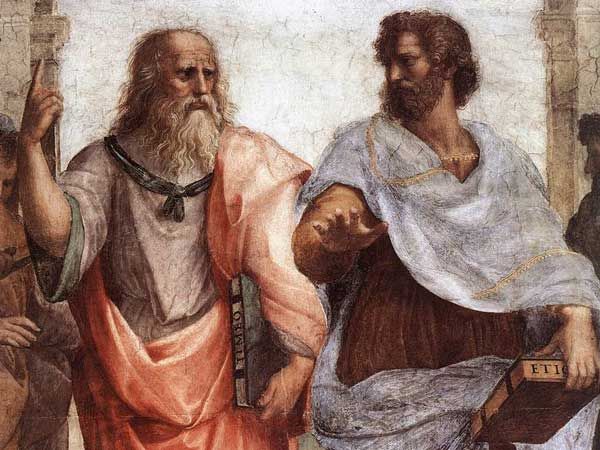
Raphael, The School of Athens (1509–1511), public domain
- The myth of Theuth and Thamus (Phaedrus 274c–275b): writing will give people “the appearance of wisdom” and weaken memory
- Passage read by the licensed AI voice of Piotr Fronczewski (ElevenLabs, 2025)
- Every new knowledge technology has raised similar fears
Part III. Definitions of artificial intelligence
Problems with defining AI
- “Intelligence” has no single definition, even in psychology
- The “AI effect”: what a machine can already do, we stop calling intelligence
- Scientific definitions describe a research goal; a legal definition sets the scope of obligations
- For a lawyer the question is: is this particular system an “AI system” within the meaning of the law?
Alan Turing (1950): “Can machines think?”
- A. M. Turing, Computing Machinery and Intelligence, Mind 59 (1950), no. 236, pp. 433–460
- Turing considered the question too vague and replaced it with the imitation game
- Instead of defining thinking, we test behaviour
- Prediction: around 2000, computers (storage of about 10⁹) would play so well that an average interrogator would correctly identify the machine after 5 minutes of questioning in at most 70% of cases
John McCarthy: the science of making intelligent machines
- The proposal for the Dartmouth conference (31.08.1955: McCarthy, Minsky, Rochester, Shannon) introduced the name artificial intelligence
- Assumption: every aspect of learning and intelligence can be described so precisely that a machine can simulate it
- McCarthy (2007): AI is “the science and engineering of making intelligent machines, especially intelligent computer programs”
Four approaches to AI
| thinking | acting | |
|---|---|---|
| humanly | cognitive modelling | Turing test |
| rationally | logic, “laws of thought” | rational agent |
- Classification by S. Russell and P. Norvig (Artificial Intelligence: A Modern Approach)
- Contemporary computer science and law mostly choose the bottom-right quadrant: an agent that acts to achieve a goal
The OECD definition (2019, revised in 2023)
- Recommendation of the OECD Council on Artificial Intelligence (2019), definition updated on 8 November 2023
- AI system: a machine-based system that, for explicit or implicit objectives, infers from the input it receives how to generate outputs (predictions, content, recommendations, decisions) that can influence physical or virtual environments
- Systems vary in their levels of autonomy and adaptiveness after deployment
- The AI Act definition is based on this definition
Article 3(1) AI Act
‘AI system’ means a machine-based system that is designed to operate with varying levels of autonomy and that may exhibit adaptiveness after deployment, and that, for explicit or implicit objectives, infers, from the input it receives, how to generate outputs such as predictions, content, recommendations, or decisions that can influence physical or virtual environments
Regulation (EU) 2024/1689, Article 3(1)
Seven elements of the definition
- a machine-based system
- designed to operate with varying levels of autonomy
- may exhibit adaptiveness after deployment
- operates for explicit or implicit objectives
- infers from the input it receives
- how to generate outputs: predictions, content, recommendations, decisions
- outputs can influence physical or virtual environments
After: Commission Guidelines on the definition of an AI system, C(2025) 5053 final (adopted 29.07.2025), para. 9
Simplifications to watch out for
- “Autonomy” does not mean “without human oversight”, but some independence of action from humans
- Adaptiveness (learning after deployment) is possible, but not necessary
- What is decisive is inference, not the mere fact that a program “computes”
What does the definition not cover?
- Recital 12: the definition does not cover simpler traditional software or systems operating solely on rules defined by natural persons
- The Commission Guidelines list, among others:
- systems for improving mathematical optimisation
- basic data processing (sorting and filtering databases, standard spreadsheets)
- systems based on classical heuristics (e.g. a chess program using the minimax algorithm)
- simple prediction systems (e.g. a forecast as the average of previous periods)
- The Guidelines are not binding: the binding interpretation will come from the CJEU
Exercise: is this an AI system?
- A spreadsheet calculating statutory interest using a formula
- A spam filter trained on labelled messages
- A bank’s credit-scoring model trained on loan history
- A case-law search engine using keywords and dates
- A chatbot answering questions about the current law
- A program that calculates court fees according to a table in a regulation
Part IV. Basic concepts
Map of AI fields
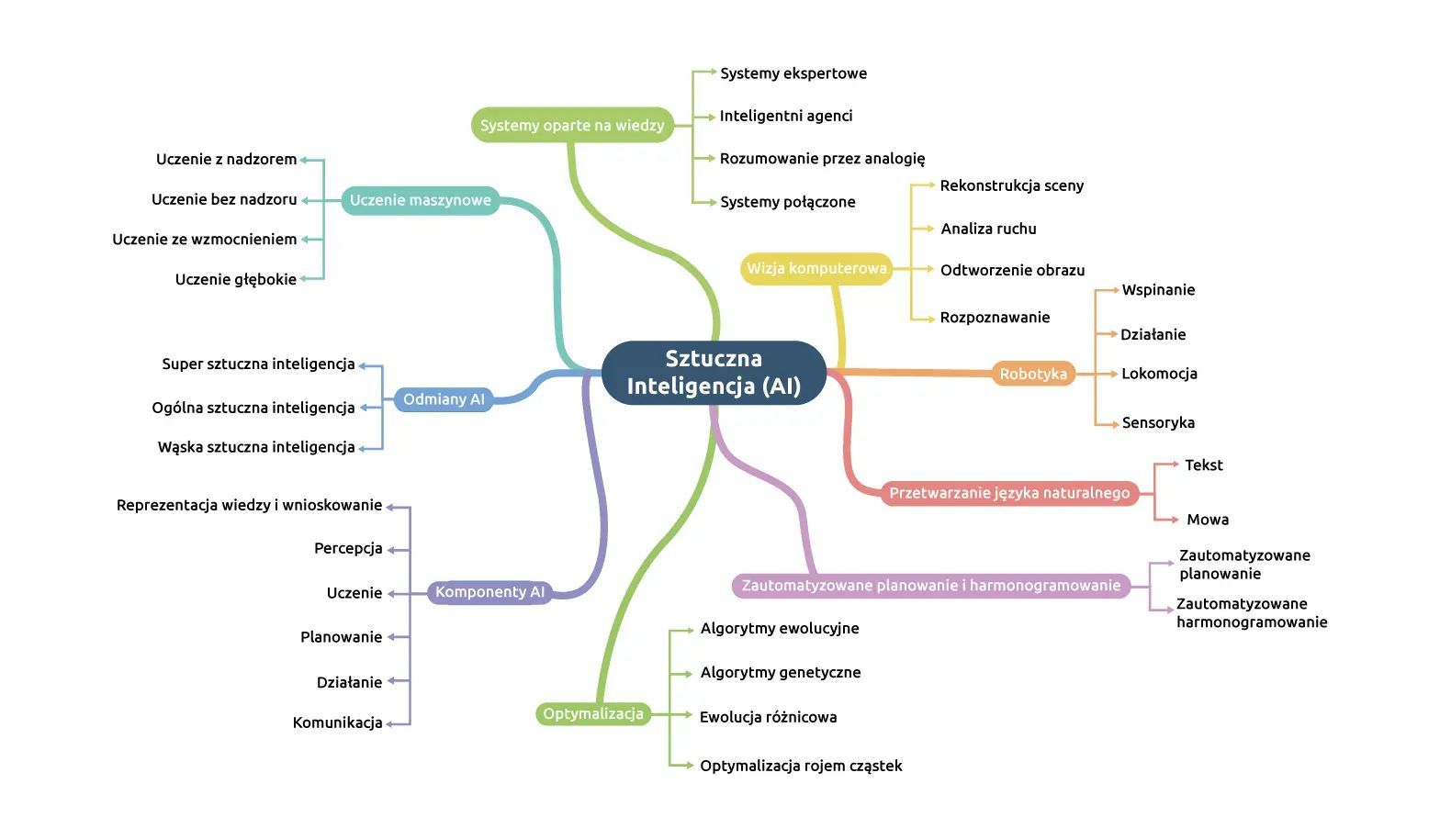
Source: Technology navigator “Sztuczna inteligencja” (Artificial intelligence), Fundacja Platforma Przemysłu Przyszłości (Future Industry Platform Foundation; dissolved on 31.12.2024; its tasks were taken over by PARP)
From general to specific
- Artificial intelligence: the whole field, including rule-based and knowledge-based systems
- Machine learning: systems that learn patterns from data instead of executing written rules
- Deep learning: machine learning using multi-layer neural networks
- Generative AI: models that create new content: text, images, sound, video
Model, training data, parameters
- Model: a mathematical function that transforms input data into an output
- Training data: examples from which the model “learns” patterns (texts, images, decisions)
- Parameters: numbers (weights) set during training; large language models have billions of them
- Training vs inference: first we train the model, then we use it
Machine learning
- The program is given not rules, but examples and a way of measuring error
- Three main types: supervised, unsupervised, reinforcement learning (details: meeting 3)
- A legal example: a model trained on thousands of contracts flags risky clauses
- Consequence: the quality of the output depends on the quality and representativeness of the data
Deep learning
- Neural networks with many layers that extract features from raw data themselves
- Breakthrough after 2012: image and speech recognition, machine translation
- Classic review: Y. LeCun, Y. Bengio, G. Hinton, Deep learning, Nature 521 (2015), pp. 436–444
- The price: huge datasets, high computing power, limited explainability (the “black box”)
Natural language processing (NLP)
- Recognising, analysing and generating text and speech in human language
- Examples: translation, summarisation, semantic search, transcription of recordings, classification of documents
- Large language models (LLMs) are today the main NLP tool
- Particularly important for law, because law is text
Generative AI
- Models that create new content based on instructions (prompts)
- Text (ChatGPT, Claude, Gemini, Bielik), images (Midjourney), sound (ElevenLabs), video (Veo)
- The output is probable, not true by definition
- The law responds: labelling of synthetic content (Article 50 AI Act), copyright disputes (meeting 7)
Part V. ANI, AGI, ASI and the Turing test
ANI, AGI, ASI
- ANI (narrow): capable in a specific task or group of tasks. This covers all of today’s systems
- AGI (general): matches humans in most cognitive tasks
- ASI (super): according to N. Bostrom, an intellect that greatly exceeds humans in virtually all domains
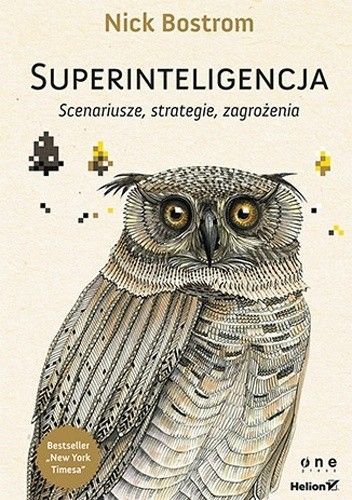
N. Bostrom, Superinteligencja (Superintelligence), Helion 2016
The Turing test: the imitation game
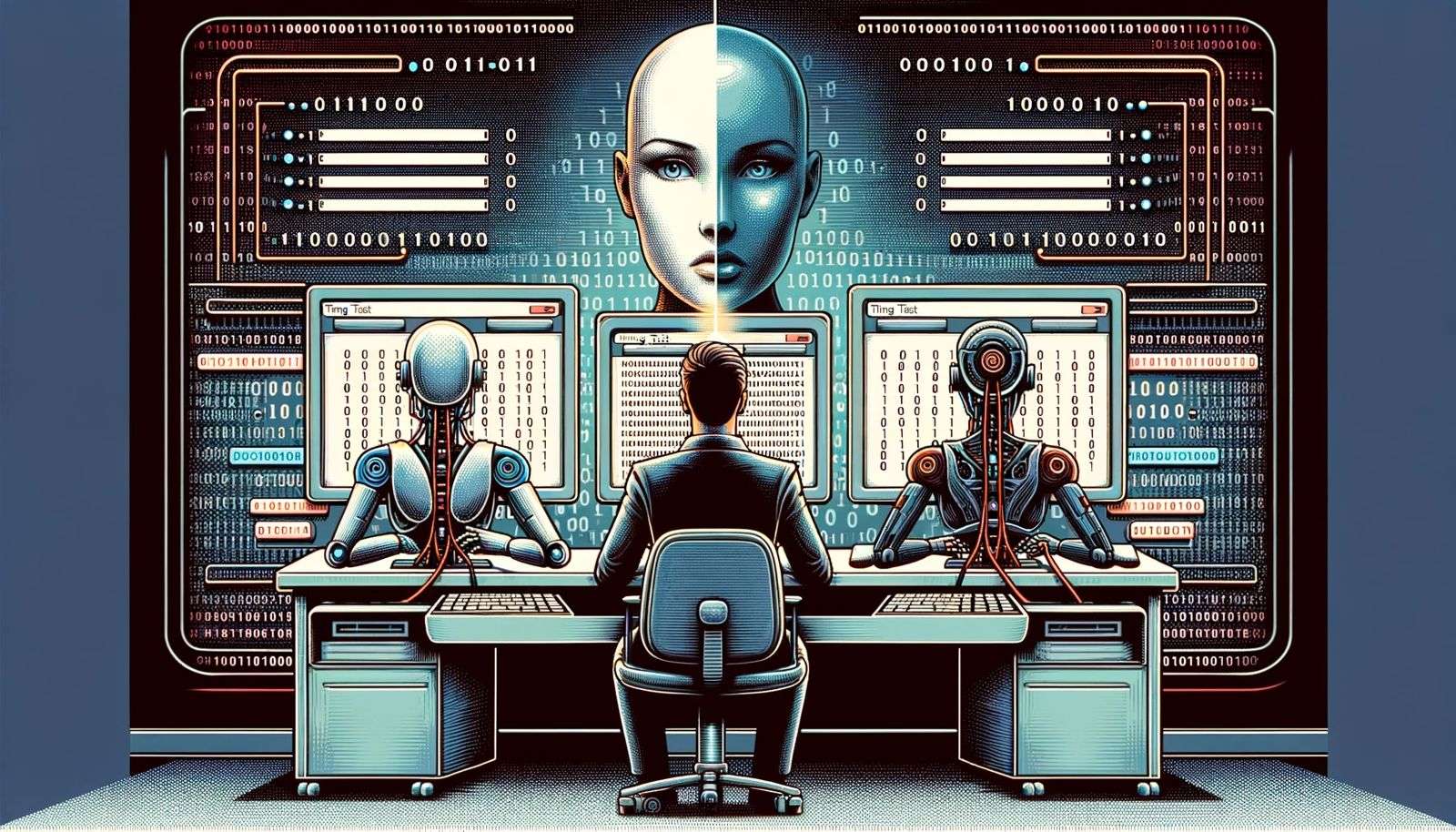
- An interrogator holds a text conversation with two interlocutors they cannot see
- If they cannot tell which one is the machine, the machine “passes” the test
Critique 1: the Chinese room (J. Searle, 1980)
- A person in a closed room arranges Chinese characters according to instructions and answers correctly, although they do not know Chinese
- From the outside it looks like understanding
- Searle’s conclusion: symbol manipulation (syntax) does not yield understanding (semantics)
- J. R. Searle, Minds, Brains, and Programs, Behavioral and Brain Sciences 3 (1980), no. 3
Critique 2: the ELIZA effect
- ELIZA (J. Weizenbaum, MIT, 1966): a simple program imitating a psychotherapist
- Users attributed understanding and empathy to it
- Conclusion: people easily anthropomorphise machines, so a test based on human judgement is easy to “fool”
- Anthropomorphisation of large models is discussed in meeting 3
Have LLMs passed the Turing test?
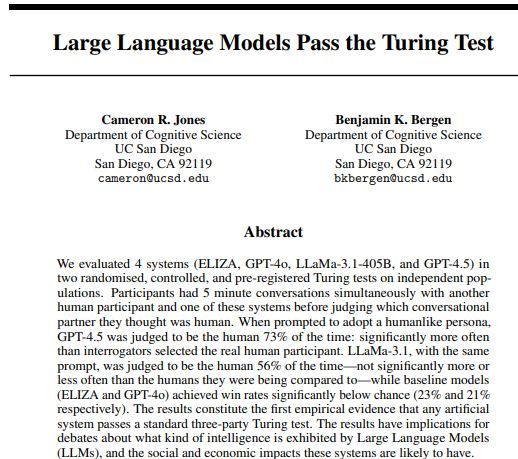
C. R. Jones, B. K. Bergen, arXiv:2503.23674 (2025)
- Three-party test: the interrogator talks simultaneously to a human and to an AI
- GPT-4.5 prompted to adopt a “humanlike persona”: judged to be human in 73% of conversations
- LLaMa-3.1-405B: 56%
- ELIZA: 23%, GPT-4o: 21%
- A year earlier (2024, two-party test): GPT-4 judged to be human in 54% of conversations
What does the Turing test actually measure?
- It measures indistinguishability, not intelligence or understanding
- It depends on the interrogator, the length of the conversation and the instructions given to the machine
- A model may “pass” the test because it is good at imitating human errors
- That is why researchers today use sets of tasks (benchmarks), and the law asks about effects, not about “thinking”
The Voight-Kampff test

- P. K. Dick, Do Androids Dream of Electric Sheep? (1968); film Blade Runner (1982); spelled “Voigt-Kampff” in the novel
- The test examines not intelligence, but empathic responses
Source of the still: Blade Runner, dir. R. Scott, 1982
Empathy as a criterion of humanity?

- The test questions concern situations that trigger a moral reflex, e.g. a calfskin wallet or a butterfly collection
- Today’s models can describe empathy very convincingly
- Does the test still work then?
Source of the still: Blade Runner, dir. R. Scott, 1982
From test to law: the reverse Turing test
- The law does not ask whether a machine thinks, but whether a person knows they are talking to a machine
- Article 50(1) AI Act: providers ensure that systems intended to interact with people inform them that they are AI systems (unless this is obvious)
- Article 50(2) and (4): labelling of synthetic content and deep fakes
- Applies from 2 August 2026
Part VI. Applications of AI and AI literacy
Where do we encounter AI every day?
- Medicine: analysis of diagnostic images, support for screening
- Finance: creditworthiness assessment, fraud detection
- Transport and logistics: navigation, route planning, driver assistance systems
- Public administration: handling enquiries, document analysis, translation
- Media and platforms: recommendations, content moderation, advertising
AI in legal practice
- Searching and analysing case law, including semantic search
- Reviewing and comparing documents (due diligence, contracts)
- Drafting pleadings and summarising case files
- Transcription of recordings and hearings
- Assistants in legal information systems: LEX Expert AI (Wolters Kluwer, 2025), Lexis+ AI, the announced Beck-Noxtua (Legalis)
- Tools for law firms: Harvey (since 2023, among others at Allen & Overy), CoCounsel (Thomson Reuters)
Risks a lawyer must keep in mind
- Hallucinations: fabricated judgments, provisions and quotations
- Professional secrecy and confidentiality of client data
- Personal data protection (GDPR)
- Liability: the legal representative, not the model, is responsible for a pleading
- Excessive trust in the output (automation bias)
Article 4 AI Act: AI literacy
Providers and deployers of AI systems shall take measures to ensure, to their best extent, a sufficient level of AI literacy of their staff and other persons dealing with the operation and use of AI systems on their behalf (…)
- Applies from 2 February 2025
- From 27 July 2026 (Regulation (EU) 2026/1744): measures “to support the development of AI literacy”; there is no need to ensure a specific level of AI literacy of individual persons
Regulation (EU) 2024/1689, Article 4 (original wording)
What is AI literacy?
- Article 3(56) AI Act: skills, knowledge and understanding that allow an informed deployment of AI systems and awareness of their opportunities, risks and possible harm
- It concerns providers, deployers and persons affected by AI
- A law firm, court or public office using AI is a deployer
- This course is one way of building such literacy
Summary
- The law defines AI functionally: a machine-based system that infers how to generate outputs
- Adaptiveness is possible but not necessary; simple rule-based software is not an AI system
- All of today’s systems are ANI, although the boundary with AGI is disputed
- The Turing test measures imitation, not understanding; the law has turned it into a disclosure obligation (Article 50)
- AI literacy (Article 4) also concerns lawyers
For the next meeting
- Meeting I (23 October 2026): how AI works (topic 3) and the history of AI, part 1 (topic 2)
- Read: Article 3(1) and recital 12 AI Act, and the Commission Guidelines on the definition of an AI system (the part on the elements of the definition)
- Reading for topic 3: A. T. Kalai et al., ‘Why Language Models Hallucinate’, 2025, excerpts; Anthropic, ‘Tracing the thoughts of a large language model’, 2025
- Task with a generative model: ask a model for a definition of AI and compare it with Article 3(1) (see exercises)
- Quiz for district 01 on the course website